
Lady Anne Clifford
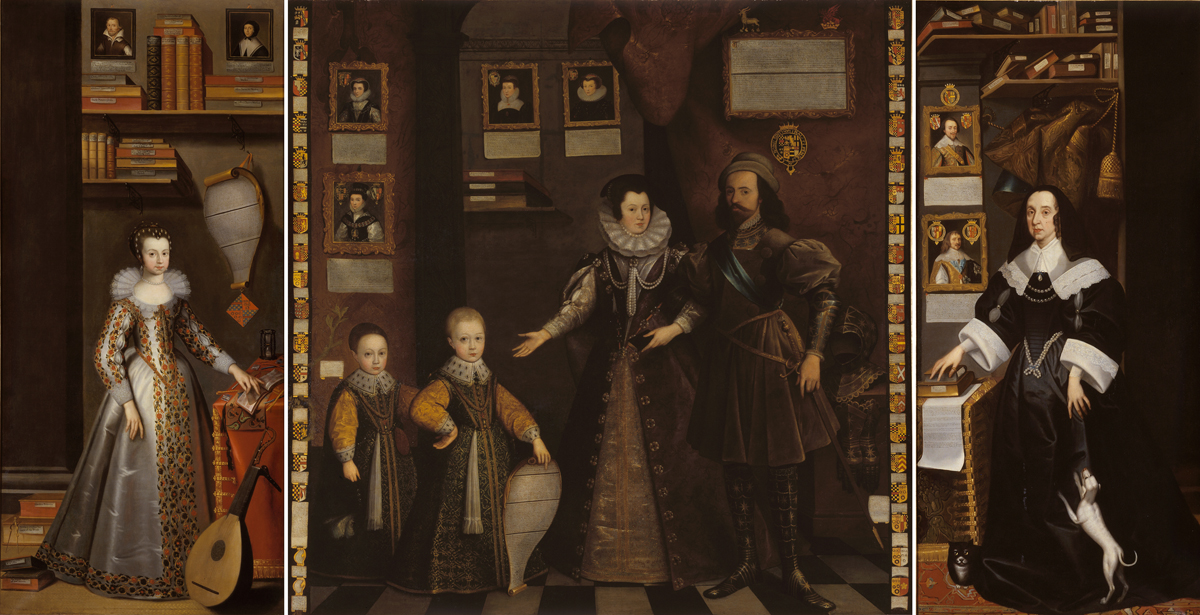
Biography and Legal Battle
Para1Lady Anne Clifford (1590–1676) was the only surviving child of Baron George Clifford
and Lady Margaret Russell. At age 15, she was the heir to an extensive barony in the
north-west of England when her father died. Her unusual inheritance occurred because
the original documents, issued during the reign of Edward II, stated that the oldest
child would inherit, no matter the gender. Clifford’s father, however, willed his
estate to his brother and his male line, with the condition that it would revert to
his daughter only if there were no male heirs. His will left his daughter £15,000—a
huge fortune at the time, but not the title as long as her male cousins survived.
This led to many years of lawsuits because of legal skepticism about a female heir
to a title. Her mother, the noted intellectual Lady Margaret Russell, was the only
one to support her daughter’s cause. Clifford’s mother even went so far as to publicly
contest her husband’s will. Anne Clifford’s male cousin in line for the title died
in 1643. After the English Civil Wars concluded, Anne Clifford took possession of
her properties and the title in 1649. She went on to lead the barony for 27 years.
She acted much like a lord by rebuilding churches, convening courts, and establishing
an almshouse for the local poor. She wrote several versions of her personal and family
history, including The Diary of Anne Clifford.
Clifford’s Marriages
Para2Anne Clifford was twice married, first in 1609 to Richard Sackville, 3rd Earl of Dorset.
They were not well-matched, as he was notorious in his extravagance and infidelities.
Her first husband pushed Clifford to give up the fight for her inheritance and accept
a cash payment, but she refused. Clifford was told by Dorset and all her male relatives,
as well as the Archbishop of Canterbury, that she was foolish to keep fighting for
her inheritance instead of accepting the money. Her husband needed the money and threated
to separate from her and go off to the court of James I to indulge himself. He also
threatened to leave her alone in one of their houses and take their child with him.
Para3Dorset died in 1624, and Clifford wed her second husband, Philip Herbert, 4th Earl
of Pembroke and Montgomery in 1630. He took her side and helped her to pursue her
rightful inheritance. Yet they, too, did not get along well, and she eventually lived
separately from him, in part due to their political and religious differences. As
England moved towards Civil War, she sided with Charles I and he sided with the Parliamentarians
who later executed Charles in 1649. Pembroke died in 1650.
Clifford the Writer
Para4Anne Clifford wrote at least four autobiographies at different stages of her life,
all of which were intended, at least in part, to justify her legal and moral claim
on her inheritance. Her diary contains significant detail about everyday life that
is missing from many other women’s diaries of the time. The diary opens with the 13-year-old
Clifford remembering the funeral of Queen Elizabeth and the surrounding events in
1603, situating Clifford at an important historical moment.
Para5Because of the disapproval that Clifford faced from almost everyone, including her
first husband, the king, and the court, she used the Bible to justify her rebellious
actions. She was a moderate Calvinist but maintained friendships with both Catholics
and Puritans during a religiously divided era.
Para6Clifford’s household growing up was mostly women, because her father was often away
at sea or court. This woman-centered household, Queen Elizabeth’s influence, and the
fact that Clifford was well-educated by a personal tutor, may have been the reason
she was able to rebel consistently and push against both law and custom. She is reported
to have smoked a pipe, worn short hair, and established a specific retirement home
for her female servants. Anne Clifford lived to be 86, although her diary was not
published until 1923 and not edited fully until 1990.
Sources
Sackville-West, Vita. The Diary of the Lady Anne Clifford. Heinemann, 1923. Published simultaneously in America by the George H. Doran Company.
Seelig, Sharon Cadman. Autobiography and Gender in Early Modern Literature: Reading Women’s Lives, 1600–1680. Cambridge University Press, 2005.
Spence, Richard T.
Clifford, Anne Known as Lady Anne Clifford, Countess of Pembroke, Dorset, and Montgomery.Oxford Dictionary of National Biography, 25 Sep. 2014, doi: 10.1093/ref:odnb/5641.
Zlatar, Antoinina Bevan.
Anne Clifford and Her Bible.Studies in English Literature, 1500–1900, vol. 57, no. 1, 2017, pp. 157–180. doi: 10.1353/sel.2017.0007.
Open-Acces Digital Resources
Anne Clifford Biography.Encyclopedia of World Biography, https://www.notablebiographies.com/supp/Supplement-Ca-Fi/Clifford-Anne.html. Accessed 18 Feb. 2023.
Best, Michael.
Lady Anne Clifford.Shakespeare’s Life and Times. Internet Shakespeare Editions, 4 Jan. 2011, https://internetshakespeare.uvic.ca/Library/SLT/literature/women%20writers/clifford.html.
Great Picture Triptych.Abbot Hall Gallery, 23 Nov. 2012, https://lakelandarts.org.uk/the-great-picture-5/.
Lady Anne Clifford. English Heritage, https://www.english-heritage.org.uk/learn/histories/women-in-history/anne-clifford/. Accessed 18 Feb. 2023.
Nicolson, Adam.
A World on the Verge of Collapse: Anthony van Dyck’s 4th Earl of Pembroke and His Family.Tate ETC, 1 Jan. 2009, https://www.tate.org.uk/tate-etc/issue-15-spring-2009/world-on-verge-collapse.
Prosopography
Janelle Jenstad
Janelle Jenstad is a Professor of English at the University of Victoria, Director
of The Map of Early Modern London, and Director of Linked Early Modern Drama Online. With Jennifer Roberts-Smith and Mark Beatrice Kaethler, she co-edited Shakespeare’s Language in Digital Media: Old Words, New Tools (Routledge). She has edited John Stow’s A Survey of London (1598 text) for MoEML and is currently editing The Merchant of Venice (with Stephen Wittek) and Heywood’s 2 If You Know Not Me You Know Nobody for DRE. Her articles have appeared in Digital Humanities Quarterly, Elizabethan Theatre, Early Modern Literary Studies, Shakespeare Bulletin, Renaissance and Reformation, and The Journal of Medieval and Early Modern Studies. She contributed chapters to Approaches to Teaching Othello (MLA); Teaching Early Modern Literature from the Archives (MLA); Institutional Culture in Early Modern England (Brill); Shakespeare, Language, and the Stage (Arden); Performing Maternity in Early Modern England (Ashgate); New Directions in the Geohumanities (Routledge); Early Modern Studies and the Digital Turn (Iter); Placing Names: Enriching and Integrating Gazetteers (Indiana); Making Things and Drawing Boundaries (Minnesota); Rethinking Shakespeare Source Study: Audiences, Authors, and Digital Technologies (Routledge); and Civic Performance: Pageantry and Entertainments in Early Modern London (Routledge). For more details, see janellejenstad.com.
Kate McPherson
Kate McPherson is Professor of English and Honors Program Director at Utah Valley
University (Orem, UT, USA). In 2015, she began working to redevelop Shakespeare’s Life and Times, created by Michael Best, into the Early Modern England Encyclopedia. Her other publications include commentary on Pericles and The Comedy of Errors for the New Oxford Shakespeare (2016); the co-edited volumes Stages of Engagement: Drama and Religion in Post-Reformation England with James Mardock (Duquesne University Press, 2014) and Shakespeare Expressed: Page, Stage, and Classroom in Shakespeare and His Contemporaries, with Kathryn M. Moncrief and Sarah Enloe (Fairleigh Dickinson University Press,
2013). With Kathryn M. Moncrief, Kate has also two edited collections, Performing Pedagogy in Early Modern England: Gender, Instruction, and Performance (Ashgate, 2011) and Performing Maternity in Early Modern England (Ashgate 2008). She has also published numerous articles on early modern maternity
in scholarly journals. Kate participated in the 2008 National Endowment for the Humanities
Institute,
Shakespeare’s Blackfriars: The Study, the Stage, the Classroom,at the American Shakespeare Center. She also served as Play Seminar Director, a public humanities position, for the Utah Shakespeare Festival in 2017 and 2018.
Leah Hamby
Leah Hamby is the primary encoder for the Early Modern England Encyclopedia. Aside from encoding, she also works as an editor for the project and contributed
several articles of her own. She has been working on the EMEE since February 2023. As of February 2026, she is soon to graduate with honours from
Utah Valley University with a major in history and a minor in creative writing. Her
other work with the LEMDO program includes remediating William Kemp’s Kemp’s Nine Day’s Wonder for the Digital Renaissance Editions.
Michael Best
Michael Best is Professor Emeritus at the University of Victoria, BC. He founded the
Internet Shakespeare Editions in 1996, and was Coordinating Editor until 2017, contributing two editions to the
ISE: King John and King Lear (the latter also available in print from Broadview Press). In print, he has published editions of works of Elizabethan magic and huswifery,
a collection of letters from the Australian goldfields, and Shakespeare on the Art of Love (2008). He contributed regular columns for the Shakespeare Newsletter on
Electronic Shakespeares,and has written many articles and chapters for both print and online books and journals, principally on questions raised by the new medium in the editing and publication of texts. He has delivered papers and plenary lectures on electronic media and the Internet Shakespeare Editions at conferences in Canada, the USA, the UK, Spain, Australia, and Japan.
Navarra Houldin
Training and Documentation Lead 2025–present. LEMDO project manager 2022–2025. Textual
remediator 2021–present. Navarra Houldin (they/them) completed their BA with a major
in history and minor in Spanish at the University of Victoria in 2022. Their primary
research was on gender and sexuality in early modern Europe and Latin America. They
are continuing their education through an MA program in Gender and Social Justice
Studies at the University of Alberta where they will specialize in Digital Humanities.
Orgography
LEMDO Team (LEMD1)
The LEMDO Team is based at the University of Victoria and normally comprises the project
director, the lead developer, project manager, junior developers(s), remediators,
encoders, and remediating editors.
University of Victoria (UVIC1)
https://www.uvic.ca/Metadata
| Authority title | Lady Anne Clifford |
| Type of text | Critical |
| Publisher | University of Victoria on the Linked Early Modern Drama Online Platform |
| Series | Early Modern England Encyclopedia |
| Source |
By Kate McPherson, inspired by Michael Best’s Shakespeare’s Life and Times, Internet Shakespeare Editions
|
| Editorial declaration | This document uses Canadian English spelling |
| Edition | Released with Early Modern England Encyclopedia 1.0 |
| Sponsor(s) |
Early Modern England EncyclopediaAnthology Leads: Kate McPherson and Kate Moncrief.
|
| Encoding description | Encoded in TEI P5 according to the LEMDO Customization and Encoding Guidelines |
| Document status | published, peer-reviewed |
| Funder(s) |
Social Sciences and Humanities Research Council of Canada
Mitacs Globalink Research Internship Utah Valley University |
| License/availability |
Unless otherwise noted, intellectual copyright in EMEE Anthology pages is held by
Kate McPherson on behalf of the contributors. Copyright on the TEI-XML markup is held by the University of Victoria on behalf of the LEMDO Team. The content and TEI-XML markup in this file are licensed under a CC BY-NC-ND 4.0 license. This file is freely downloadable without permission under the following conditions:
(1) credit must be given to the authors, EMEE, and LEMDO in any subsequent use of
the files and /or data; (2) this availability statement must remain in the file; (3)
the content cannot be adapted or repurposed (except for quotations for the purposes
of academic review and citation); and (4) commercial uses are not permitted without
the knowledge and consent of the authors, EMEE, and LEMDO. Neither the content nor
the code in this file is licensed for training large language models (LLMs), ingestion
into an LLM, or any use in any artificial intelligence applications; such uses are
considered to be commercial uses and are strictly prohibited.
|