
Anne Boleyn
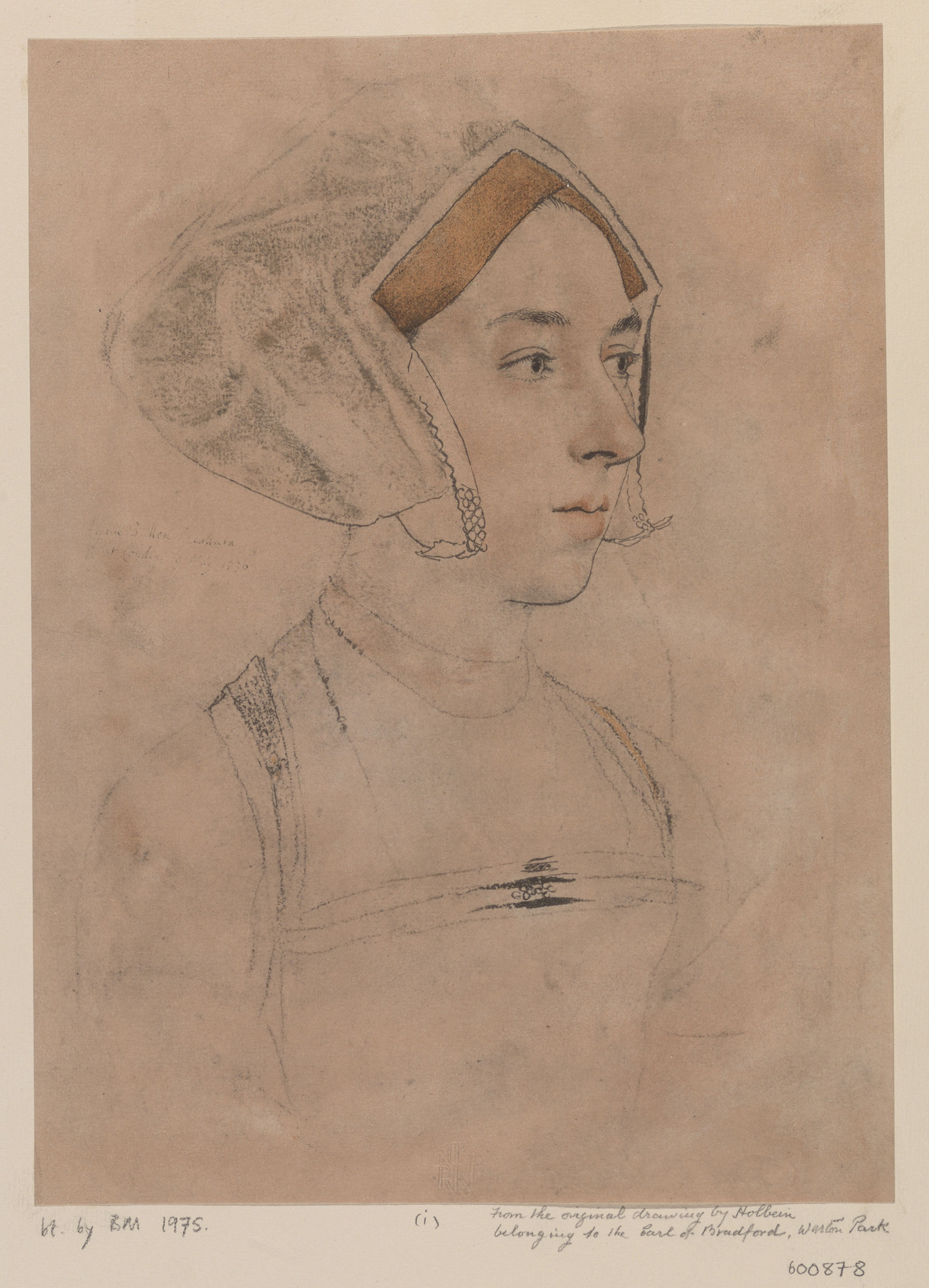
Para1Anne Boleyn, King Henry VIII’s second wife, was arguably
the most controversial and famous of Henry’s six wives. Her impact on English
politics and religion makes her a notable figure in England’s history, particularly
in the person of her daughter, who would become Elizabeth I. Anne Boleyn (sometimes
spelled Bullen) also appears as a character in the historical play
Henry VIII, co-written by William Shakespeare and John
Fletcher in 1613.
Early Life
Para2Anne Boleyn was born in 1501 in Norfolk to Sir Thomas and
Lady Elizabeth Boleyn, a prominent aristocratic family. Anne had two siblings, Mary
and George, and grew up in Hever Castle in Kent. She may have received a humanist
education alongside her siblings, one stressing languages and literature.
Para3Anne began her more formal education in the court of
Margaret of Austria, Duchess of Savoy in Mechelen, Belgium in 1513. Margaret was
daughter of Maximilian I, the Holy Roman Emperor who ruled much of central Europe,
and she maintained a sophisticated court, one rich with literature, art, and humanist
ideals.
Para4In 1514, Anne was selected to accompany Henry Tudor’s
sister, Mary, as a maid of honor when Mary went to the French court to wed King Louis
XII. When Louis died a few months later, Mary Tudor returned home to England, and
Anne began to serve in the court of Queen Claude, where she spent the next six years.
Anne’s years in France were fruitful, and she learned its language, art, and fashion.
Anne learned the subtle arts required to interact at the court, as well as
association with many powerful and influential European nobles and rulers, possibly
meeting Henry VIII when he visited France for the Field of the Cloth of Gold
ceremonies in 1518. In 1522, Anne returned home to England and became a maid of honor
for King Henry VIII’s first wife, Catherine of Aragon.
Relationship with Henry VIII
Para5After a couple of failed betrothals, Anne entered into an
affair with King Henry VIII in about 1526, although he had already been involved in
an affair with Anne’s married sister, Mary. Anne famously resisted his desire to
consummate their affair until they were married. She and King Henry VIII were
eventually married in secret in January 1533 while he was still married to Catherine.
King Henry VIII’s marriage to Catherine was one he deemed improper, even incestuous,
because she was initially married to Henry’s brother, Prince Arthur, before he died.
That argument of an improper marriage was the basis for King Henry VIII’s appeal to
the pope for a divorce.
Para6The king’s desire to marry Anne and divorce Catherine was
a major driver in the English Reformation because Pope Clement VII wouldn’t grant
him
a divorce. When Archbishop of Canterbury, Thomas Cranmer, declared the marriage of
King Henry VIII and Catherine as null and void, subsequently validating the secret
marriage of King Henry VIII and Anne Boleyn, the split from the Catholic Church
accelerated. The tides of religious reform in England led to the formation of The
Church of England, which was made official in 1535 with the Act of Supremacy.
Anne Bolelyn’s Legacy
Para7Anne and King Henry VIII had one child in September 1533
and named her Elizabeth; she would later become Queen Elizabeth I. After Anne
experienced several failed pregnancies over the next two years, King Henry VIII began
to believe that Anne would not be able to bear him a proper male heir, and so he
became restless and desired to be rid of Anne.
Para8King Henry VIII may already have been courting his next
wife, Jane Seymour, when he initiated the legal investigation and prosecution of
Anne. Anne was put on trial for charges, brought by the king, for the crimes of high
treason, adultery, and incest. Anne was found guilty and sentenced to death. At her
execution, Anne protested her innocence and praised Henry:
I am come hither to die, for according to the law and by the law I am judged to die, and therefore I will speak nothing against it […] \ I pray God save the King […] for a gentler nor a more merciful prince was there never.On May 19, 1536, Anne became the first English queen to be executed when she was beheaded at the Tower of London. She is buried in the Chapel of St. Peter ad Vincula inside the Tower’s grounds. Many historians speculate that Anne’s difficult marriage and tragic end influenced her daughter Elizabeth’s decision to remain single.
Key Print Sources
Ives, Eric. The Life and Death of Anne
Boleyn. Blackwell
Publishing, 2005.
Shakespeare, William. King Henry the
Eighth. Edited by and J. C. Maxwell.
Cambridge University Press,
1969.
Warnicke, Retha M. The Rise and Fall of Anne
Boleyn: Family Politics at the Court of Henry VIII. Cambridge University Press,
1989.
Key Online Sources
Anne Boleyn.Historical Royal Palaces. https://www.hrp.org.uk/tower-of-london/history-and-stories/anne-boleyn/. Accessed 6 Feb. 2023.
Bevan, Richard.
Anne Boleyn and the Downfall of her Family.BBC History. https://www.bbc.co.uk/history/british/tudors/anne_boleyn_01.shtml. Accessed 18 Sep. 2018.
Editors of Encyclopaedia Britannica.
Anne Boleyn.Encyclopedia Britannica. 17 May 2018. https://www.britannica.com/biography/Anne-Boleyn. Accessed 16 Sep. 2018.
Prosopography
Janelle Jenstad
Janelle Jenstad is a Professor of English at the University of Victoria, Director
of The Map of Early Modern London, and Director of Linked Early Modern Drama Online. With Jennifer Roberts-Smith and Mark Beatrice Kaethler, she co-edited Shakespeare’s Language in Digital Media: Old Words, New Tools (Routledge). She has edited John Stow’s A Survey of London (1598 text) for MoEML and is currently editing The Merchant of Venice (with Stephen Wittek) and Heywood’s 2 If You Know Not Me You Know Nobody for DRE. Her articles have appeared in Digital Humanities Quarterly, Elizabethan Theatre, Early Modern Literary Studies, Shakespeare Bulletin, Renaissance and Reformation, and The Journal of Medieval and Early Modern Studies. She contributed chapters to Approaches to Teaching Othello (MLA); Teaching Early Modern Literature from the Archives (MLA); Institutional Culture in Early Modern England (Brill); Shakespeare, Language, and the Stage (Arden); Performing Maternity in Early Modern England (Ashgate); New Directions in the Geohumanities (Routledge); Early Modern Studies and the Digital Turn (Iter); Placing Names: Enriching and Integrating Gazetteers (Indiana); Making Things and Drawing Boundaries (Minnesota); Rethinking Shakespeare Source Study: Audiences, Authors, and Digital Technologies (Routledge); and Civic Performance: Pageantry and Entertainments in Early Modern London (Routledge). For more details, see janellejenstad.com.
Kate McPherson
Kate McPherson is Professor of English and Honors Program Director at Utah Valley
University (Orem, UT, USA). In 2015, she began working to redevelop Shakespeare’s Life and Times, created by Michael Best, into the Early Modern England Encyclopedia. Her other publications include commentary on Pericles and The Comedy of Errors for the New Oxford Shakespeare (2016); the co-edited volumes Stages of Engagement: Drama and Religion in Post-Reformation England with James Mardock (Duquesne University Press, 2014) and Shakespeare Expressed: Page, Stage, and Classroom in Shakespeare and His Contemporaries, with Kathryn M. Moncrief and Sarah Enloe (Fairleigh Dickinson University Press,
2013). With Kathryn M. Moncrief, Kate has also two edited collections, Performing Pedagogy in Early Modern England: Gender, Instruction, and Performance (Ashgate, 2011) and Performing Maternity in Early Modern England (Ashgate 2008). She has also published numerous articles on early modern maternity
in scholarly journals. Kate participated in the 2008 National Endowment for the Humanities
Institute,
Shakespeare’s Blackfriars: The Study, the Stage, the Classroom,at the American Shakespeare Center. She also served as Play Seminar Director, a public humanities position, for the Utah Shakespeare Festival in 2017 and 2018.
Leah Hamby
Leah Hamby is the primary encoder for the Early Modern England Encyclopedia. Aside from encoding, she also works as an editor for the project and contributed
several articles of her own. She has been working on the EMEE since February 2023. As of February 2026, she is soon to graduate with honours from
Utah Valley University with a major in history and a minor in creative writing. Her
other work with the LEMDO program includes remediating William Kemp’s Kemp’s Nine Day’s Wonder for the Digital Renaissance Editions.
Melanee Raynes
Melanee Raynes was a student at Utah Valley University.
Navarra Houldin
Training and Documentation Lead 2025–present. LEMDO project manager 2022–2025. Textual
remediator 2021–present. Navarra Houldin (they/them) completed their BA with a major
in history and minor in Spanish at the University of Victoria in 2022. Their primary
research was on gender and sexuality in early modern Europe and Latin America. They
are continuing their education through an MA program in Gender and Social Justice
Studies at the University of Alberta where they will specialize in Digital Humanities.
Orgography
LEMDO Team (LEMD1)
The LEMDO Team is based at the University of Victoria and normally comprises the project
director, the lead developer, project manager, junior developers(s), remediators,
encoders, and remediating editors.
University of Victoria (UVIC1)
https://www.uvic.ca/Metadata
| Authority title | Anne Boleyn |
| Type of text | Critical |
| Publisher | University of Victoria on the Linked Early Modern Drama Online Platform |
| Series | Early Modern England Encyclopedia |
| Source |
By Melanee Raynes and Kate McPherson, inspired by Michael Best’s Shakespeare’s Life and Times, Internet Shakespeare Editions
|
| Editorial declaration | This document uses Canadian English spelling |
| Edition | Released with Early Modern England Encyclopedia 1.0 |
| Sponsor(s) |
Early Modern England EncyclopediaAnthology Leads: Kate McPherson and Kate Moncrief.
|
| Encoding description | Encoded in TEI P5 according to the LEMDO Customization and Encoding Guidelines |
| Document status | published, peer-reviewed |
| Funder(s) |
Social Sciences and Humanities Research Council of Canada
Mitacs Globalink Research Internship Utah Valley University |
| License/availability |
Unless otherwise noted, intellectual copyright in EMEE Anthology pages is held by
Kate McPherson on behalf of the contributors. Copyright on the TEI-XML markup is held by the University of Victoria on behalf of the LEMDO Team. The content and TEI-XML markup in this file are licensed under a CC BY-NC-ND 4.0 license. This file is freely downloadable without permission under the following conditions:
(1) credit must be given to the authors, EMEE, and LEMDO in any subsequent use of
the files and /or data; (2) this availability statement must remain in the file; (3)
the content cannot be adapted or repurposed (except for quotations for the purposes
of academic review and citation); and (4) commercial uses are not permitted without
the knowledge and consent of the authors, EMEE, and LEMDO. Neither the content nor
the code in this file is licensed for training large language models (LLMs), ingestion
into an LLM, or any use in any artificial intelligence applications; such uses are
considered to be commercial uses and are strictly prohibited.
|