
Alchemy and Chemistry in the Early Modern Era
Para1At the turn of the 17th century, chemistry was in the early stages of development;
scientists had not yet discovered a format with which to successfully describe and
classify chemicals. In the 1600s, there was no difference between chemistry and alchemy. Both words were used to mean the same practice: a combination of what we today would
call scientific chemistry and mystical alchemy. Alchemy was the discipline that influenced
the origins of modern chemistry; it combined scientific experiments with astrology
and other forms of mysticism to attempt to create new substances and understand the
world.
Alchemy
Para2Alchemy was a diverse field of inquiry that had ethical, mystical, medical, and metallurgical
connections. Through their research into herbs, metals, and astrology, alchemists
were convinced they could produce the philosopher’s stone, which is defined by Oxford’s Dictionary of Reference and Allusion as
an imaginary substance, sought after by alchemists, that was supposed to have the power of changing base metals into gold and sometimes of curing all diseases and prolonging life indefinitely.The ancient, global art of alchemy claimed that research and experiments could categorize matter, primarily the four elements of earth, air, fire, and water.
A Transformed Reputation
Para3In the early modern era, alchemy evolved from a mystical to a more scientific pursuit.
Previously, alchemists concealed their work out of fear of punishment, including death.
The fear of punishment led alchemists to develop symbols to code their work, making
it less obvious to officials. As the 1600s approached, the secrets of alchemy began
to be uncovered, and it started to become more widely practiced and accepted. Scientific
pioneers Robert Boyle and Isaac Newton both investigated alchemical principles.
Noteworthy Names
Paracelsus
Para4Phillipus Aureolus Theophrastus Bombastus von Hohenheim, known as Paracelsus, known
as the Father of Toxicology, was born in Switzerland in 1493. Paracelsus believed
that there were only three basic elements: mercury, salt, and sulphur. Through his
research, Paracelsus applied chemistry to medicine. Paracelsus was primarily interested
in investigating the causes of disease, life and death, and humanity’s relationships
with itself and the universe. He often used chemistry as a mode of teaching his medical
students and speaking to others in the medical field. Paracelsus focused his research
on finding cures for diseases instead of depending on medication, despite how effective
herbal compounds may have been.
Andreas Libavius
Para5Andreas Libavius was a German alchemist who was born in the 1540s. In 1559, Libavius
wrote Alchemia, considered by some as the first chemistry textbook. Alchemia put the general knowledge of alchemists into language that any educated reader could
understand. Libavius was one of the first alchemists to reject secrecy and work towards
making information on alchemy easily accessible.
John Dee
Para6John Dee was Queen Elizabeth I’s astrologer and alchemist. He was equally famous and
infamous in his own time. He mixed science and the occult and believed that he could
speak to angels in their own language. Dee’s alchemical experiments, which he presented
in Queen Elizabeth I’s court, showed how far alchemy had come from being a crime punishable
by death.
Robert Boyle
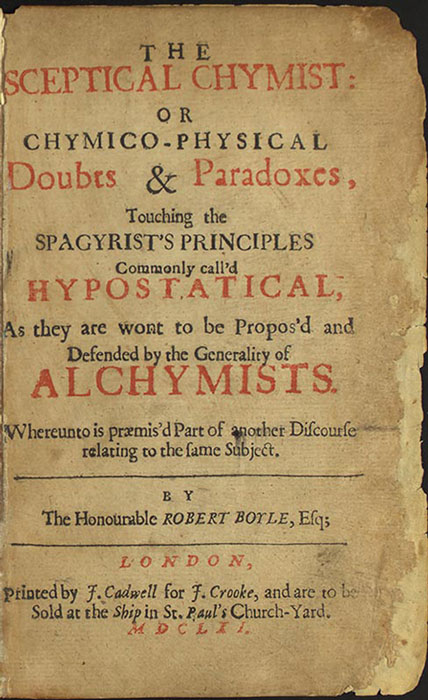
Para7Robert Boyle is known as the leading English chemist of the seventeenth century and
the father of modern chemistry. In 1661, Boyle published The Skeptical Chymist, in which he argues against the four-elements theory and instead asserts that not
all substances could be broken down into four elements. Boyle’s goal was to help chemists
determine the makeup of matter through scientific observations. Boyle also rejected
alchemical secrecy, believing that secrets interfered with the progress of knowledge.
Connections to Theatre
Para8Ben Jonson, one of early modern London’s most renowned playwrights, used the period’s
fascination with alchemy as the basis for an entire play. Jonson’s 1610 play The Alchemist takes place during a plague outbreak in London. A wealthy man named Lovewit leaves
his property in the care of his butler, Face, to escape the plague by leaving the
city. In his absence, the play’s main characters, Face, Doll, and Subtle, deceive
the people of London into thinking that Subtle, a conman, is a skilled alchemist who
can grant their wishes. One of their victims, Sir Epicure Mammon, requests that Subtle
create the philosopher’s stone, which he believes will bring him all that he desires
since the stone has the ability to turn base metals into gold and even grant eternal
life. In Act 2, Scene 3, Face and Subtle use random alchemical language to trick Mammon
into believing they are experienced alchemists. The play reveals the fascination alchemy
held in the popular imagination.
Sources
Bianchi, Massimo Luigi.
The Visible and the Invisible: From Alchemy to Paracelsus.Alchemy and Chemistry in the 16th and 17th Centuries, edited by Piyo Rattansi and Antonio Clericuzio, Springer Dordrecht, 1994, pp. 17-50.
Borzelleca, J. F. Paracelsus: Herald of Modern Toxicology. Toxicological Sciences, vol. 53, no. 1, 2000, pp. 2-4. doi: https://doi.org/10.1093/toxsci/53.1.2.
Delahunty, Andrew, and Sheila Dignen.
Philosopher’s Stone.A Dictionary of Reference and Allusion, 3rd ed., Oxford UP, 2012.
De Vries, Lyke.
Protecting Academia and Religion: Andreas Libavius’s Criticism of a General Reformation.Ambix, vol. 69, no. 1, 2022, pp. 34-48.
Jonson, Ben. The Alchemist, edited by John Greenwood, A Broadview Anthology of British Literature Edition, Broadview Press, 2020.
Levere, Trevor Harvey. Transforming Matter: A History of Chemistry from Alchemy to the Buckyball. John Hopkins UP, 2001.
Rocke, A. J.
Alchemy.The Oxford Companion to the History of Modern Science, edited by John L. Heilbron, Oxford UP, 2003.
Michaleas, Spyros N., et al.
Theophrastus Bombastus Von Hohenheim (Paracelsus) (1493–1541): The Eminent Physician and Pioneer of Toxicology.Toxicology Reports, vol. 8, 8 Jan. 2021, pp. 411-414. doi: 10.1016/j.toxrep.2021.02.012.
Open-Access Digital Resources
Alchemy to Chemistry—the Start of a Modern Science.RMIT University Learning Lab, 2 Dec. 2021, https://learninglab.rmit.edu.au/chemistry/introduction-chemistry/alchemy-chemistry/. Accessed 11 Feb. 2026.
Fessenden, Maris.
A Painting of John Dee, Astrologer to Queen Elizabeth I, Contains a Hidden Ring of Skulls: The life and Work of John Dee Contained a Strange Mix of Science and Magic.Smithsonian Magazine, 18 Jan. 2016, https://www.smithsonianmag.com/smart-news/a-painting-of-john-dee-astrologer-to-queen-elizabeth-i-contains-a-hidden-ring-of-skulls-180957860/. Accessed 11 Feb. 2026.
Murray, Stacey R.
From Alchemy to Chemistry.Encyclopedia.com, 24 Jan. 2022, https://www.encyclopedia.com/science/encyclopedias-almanacs-transcripts-and-maps/alchemy-chemistry. Accessed 11 Feb. 2026.
Owens, Rebekah.
Shakespeare and Medicine: Friar Lawrence.Shakespeare Birthplace Trust, 2018, https://www.shakespeare.org.uk/explore-shakespeare/blogs/shakespeare-and-medicine-friar-lawrence/. Accessed 11 Feb. 2026.
Image Sources
Boyle, Robert. Title Page of The Sceptical Chymist: or Chymico-Physical Doubts & Paradoxes. London: For J. Crooke, 1661. Project Gutenberg, 8 Oct. 2007, https://www.gutenberg.org/files/22914/22914-h/22914-h.htm. Accessed 11 Feb. 2026.
Prosopography
Amy Cook
Amy Cook was a student at the University of Fraser Valley.
Janelle Jenstad
Janelle Jenstad is a Professor of English at the University of Victoria, Director
of The Map of Early Modern London, and Director of Linked Early Modern Drama Online. With Jennifer Roberts-Smith and Mark Beatrice Kaethler, she co-edited Shakespeare’s Language in Digital Media: Old Words, New Tools (Routledge). She has edited John Stow’s A Survey of London (1598 text) for MoEML and is currently editing The Merchant of Venice (with Stephen Wittek) and Heywood’s 2 If You Know Not Me You Know Nobody for DRE. Her articles have appeared in Digital Humanities Quarterly, Elizabethan Theatre, Early Modern Literary Studies, Shakespeare Bulletin, Renaissance and Reformation, and The Journal of Medieval and Early Modern Studies. She contributed chapters to Approaches to Teaching Othello (MLA); Teaching Early Modern Literature from the Archives (MLA); Institutional Culture in Early Modern England (Brill); Shakespeare, Language, and the Stage (Arden); Performing Maternity in Early Modern England (Ashgate); New Directions in the Geohumanities (Routledge); Early Modern Studies and the Digital Turn (Iter); Placing Names: Enriching and Integrating Gazetteers (Indiana); Making Things and Drawing Boundaries (Minnesota); Rethinking Shakespeare Source Study: Audiences, Authors, and Digital Technologies (Routledge); and Civic Performance: Pageantry and Entertainments in Early Modern London (Routledge). For more details, see janellejenstad.com.
Kate McPherson
Kate McPherson is Professor of English and Honors Program Director at Utah Valley
University (Orem, UT, USA). In 2015, she began working to redevelop Shakespeare’s Life and Times, created by Michael Best, into the Early Modern England Encyclopedia. Her other publications include commentary on Pericles and The Comedy of Errors for the New Oxford Shakespeare (2016); the co-edited volumes Stages of Engagement: Drama and Religion in Post-Reformation England with James Mardock (Duquesne University Press, 2014) and Shakespeare Expressed: Page, Stage, and Classroom in Shakespeare and His Contemporaries, with Kathryn M. Moncrief and Sarah Enloe (Fairleigh Dickinson University Press,
2013). With Kathryn M. Moncrief, Kate has also two edited collections, Performing Pedagogy in Early Modern England: Gender, Instruction, and Performance (Ashgate, 2011) and Performing Maternity in Early Modern England (Ashgate 2008). She has also published numerous articles on early modern maternity
in scholarly journals. Kate participated in the 2008 National Endowment for the Humanities
Institute,
Shakespeare’s Blackfriars: The Study, the Stage, the Classroom,at the American Shakespeare Center. She also served as Play Seminar Director, a public humanities position, for the Utah Shakespeare Festival in 2017 and 2018.
Leah Hamby
Leah Hamby is the primary encoder for the Early Modern England Encyclopedia. Aside from encoding, she also works as an editor for the project and contributed
several articles of her own. She has been working on the EMEE since February 2023. As of February 2026, she is soon to graduate with honours from
Utah Valley University with a major in history and a minor in creative writing. Her
other work with the LEMDO program includes remediating William Kemp’s Kemp’s Nine Day’s Wonder for the Digital Renaissance Editions.
Melissa Walter
Melissa Walter is Associate Professor of English at the University of the Fraser Valley.
Her research focuses on early modern English drama and English and European prose
fiction. She is the author of The Italian Novella and Shakespeare’s Comic Heroines (U of Toronto, 2019), and co-editor, with Dennis Britton, of Rethinking Shakespeare Source Study: Authors, Audiences, Digital Technologies (Routledge, 2018). Her work on English theatre and the European novella has appeared
in several edited collections, including Transnational Exchange in Early Modern Theater (Ashgate, 2008), and Transnational Mobility in Early Modern Theater (Ashgate, 2012). She has also written about
Translation and Identity in the Dialogues in English and Malaiane Languages(Indographies, ed. Jonathan Gil Harris. Palgrave 2012). At the University of the Fraser Valley, she is a lead coordinator of UFV’s Shakespeare and Reconciliation Garden.
Navarra Houldin
Training and Documentation Lead 2025–present. LEMDO project manager 2022–2025. Textual
remediator 2021–present. Navarra Houldin (they/them) completed their BA with a major
in history and minor in Spanish at the University of Victoria in 2022. Their primary
research was on gender and sexuality in early modern Europe and Latin America. They
are continuing their education through an MA program in Gender and Social Justice
Studies at the University of Alberta where they will specialize in Digital Humanities.
Veronica Mini
Veronica Mini is an international student from Italy majoring in Mechanical Engineering
at Utah Valley University. She has a strong interest in automotive engineering and
experience in website design, including work with the UVU Honors Program.
Orgography
LEMDO Team (LEMD1)
The LEMDO Team is based at the University of Victoria and normally comprises the project
director, the lead developer, project manager, junior developers(s), remediators,
encoders, and remediating editors.
University of Victoria (UVIC1)
https://www.uvic.ca/Metadata
| Authority title | Alchemy and Chemistry in the Early Modern Era |
| Type of text | Critical |
| Publisher | University of Victoria on the Linked Early Modern Drama Online Platform |
| Series | Early Modern England Encyclopedia |
| Source |
By Amy Cook, inspired by Michael Best’s Shakespeare’s Life and Times, Internet Shakespeare Editions
|
| Editorial declaration | This document uses Canadian English spelling |
| Edition | Released with Early Modern England Encyclopedia 1.0 |
| Sponsor(s) |
Early Modern England EncyclopediaAnthology Leads: Kate McPherson and Kate Moncrief.
|
| Encoding description | Encoded in TEI P5 according to the LEMDO Customization and Encoding Guidelines |
| Document status | published, peer-reviewed |
| Funder(s) |
Social Sciences and Humanities Research Council of Canada
Mitacs Globablink Research Internship |
| License/availability |
Intellectual copyright in this entry is held by Kate McPherson on behalf of the contributors. Copyright on the TEI-XML markup is held by the University of Victoria on behalf of the LEMDO Team. The content and TEI-XML markup in this file are licensed under a CC BY-NC_ND 4.0 license. This file is freely downloadable without permission under the following conditions:
(1) credit must be given to the authors, EMEE, and LEMDO in any subsequent use of
the files and /or data; (2) this availability statement must remain in the file; (3)
the content cannot be adapted or repurposed (except for quotations for the purposes
of academic review and citation); and (4) commercial uses are not permitted without
the knowledge and consent of the authors, EMEE, and LEMDO. Neither the content nor
the code in this file is licensed for training large language models (LLMs), ingestion
into an LLM, or any use in any artificial intelligence applications; such uses are
considered to be commercial uses and are strictly prohibited.
|