<?xml version="1.0" encoding="UTF-8"?>
<?xml-model href="../sch/tei_all_LEMDO.rng" type="application/xml" schematypens="http://relaxng.org/ns/structure/1.0"?>
<?xml-model href="../sch/tei_all_LEMDO.rng" type="application/xml" schematypens="http://purl.oclc.org/dsdl/schematron"?>
<TEI xmlns="http://www.tei-c.org/ns/1.0" xml:id="emee_TheDyer">
   <teiHeader>
      <fileDesc>
         <titleStmt>
            <title type="main">Dyeing Cloth in the 16th &amp; 17th Century</title>
            <title type="alpha">Dyeing Cloth in the 16th &amp; 17th Century</title>
            <respStmt>
               <resp ref="#aut">Author</resp>
               <persName ref="#BORN1">Tyler Born</persName>
            </respStmt>
            <respStmt>
               <resp ref="#edt_sup">Supervising Editor</resp>
               <persName ref="#WALT1">Melissa Walter</persName>
            </respStmt>
            <respStmt>
               <resp ref="#edt">Editor</resp>
               <persName ref="#MCPH1">Kate McPherson</persName>
            </respStmt>
            <respStmt>
               <resp ref="#edt_cpy">Copy Editor</resp>
               <persName ref="#HAMB1">Leah Hamby</persName>
            </respStmt>
            <respStmt>
               <resp ref="#edt_mrk">Senior Encoder</resp>
               <persName ref="#HAMB1">Leah Hamby</persName>
            </respStmt>
            <respStmt>
               <resp ref="#edt_mrk">Encoding and Metadata</resp>
               <orgName ref="#LEMD1">LEMDO Team</orgName>
            </respStmt>
            <respStmt>
               <resp ref="#cph">Copyright Holder (Content)</resp>
               <persName ref="#MCPH1">Kate McPherson</persName>
            </respStmt>
            <respStmt>
               <resp ref="#cph">Copyright Holder (XML and interface)</resp>
               <orgName ref="#UVIC1">University of Victoria</orgName>
            </respStmt>
            <sponsor>
               <orgName>
                  <reg>Early Modern England Encyclopedia</reg>
                  <abbr>EMEE</abbr>
               </orgName>
               <note>
                  <p>Anthology Leads: Kate McPherson and Kate Moncrief.</p>
               </note>
            </sponsor>
            <funder>
               <ref target="https://www.sshrc-crsh.gc.ca/">Social Sciences and Humanities Research Council of Canada</ref>
            </funder>
            <funder>
               <ref target="https://www.mitacs.ca/our-programs/globalink-research-internship-students/">Mitacs Globablink Research Internship</ref>
            </funder>
         </titleStmt>
         <editionStmt>
            <p>Released with Early Modern England Encyclopedia 1.0a</p>
         </editionStmt>
         <publicationStmt>
            <publisher>University of Victoria on the Linked Early Modern Drama Online Platform</publisher>
            <availability>
               <licence from="2026-02-12" resp="#MCPH1" corresp="emee.xml"/>
               <licence from="2026-02-12" resp="#MCPH1" corresp="lemdo.xml"/>
               <p>Intellectual copyright in this entry is held by <persName ref="#MCPH1">Kate McPherson</persName> on behalf of the contributors. Copyright on the TEI-XML markup is held by the <orgName ref="#UVIC1">University of Victoria</orgName> on behalf of the <orgName ref="#LEMD1">LEMDO Team</orgName>. The content and TEI-XML markup in this file are licensed under a <ref target="https://creativecommons.org/licenses/by-nc-nd/4.0/">CC BY-NC_ND 4.0 license</ref>. This file is freely downloadable without permission under the following conditions: (1) credit must be given to the authors, EMEE, and LEMDO in any subsequent use of the files and /or data; (2) this availability statement must remain in the file; (3) the content cannot be adapted or repurposed (except for quotations for the purposes of academic review and citation); and (4) commercial uses are not permitted without the knowledge and consent of the authors, EMEE, and LEMDO. Neither the content nor the code in this file is licensed for training large language models (LLMs), ingestion into an LLM, or any use in any artificial intelligence applications; such uses are considered to be commercial uses and are strictly prohibited.</p>
            </availability>
         </publicationStmt>
         <seriesStmt>
            <p>Early Modern England Encyclopedia</p>
         </seriesStmt>
         <sourceDesc>
            <p>By Tyler Born, inspired by <persName ref="#BEST1">Michael Best</persName>’s <title level="m">Shakespeare’s Life and Times</title>, <title level="s">Internet Shakespeare Editions</title></p>
         </sourceDesc>
      </fileDesc>
      <profileDesc copyOf="#">
         <textClass>
            <catRef scheme="#emdDocumentTypes"
                    target="TAXO1.xml#ldtBornDigParatextCritical"/>
            <catRef scheme="#encyKey" target="TAXO1.xml#encyCultureDailyLifeClothing"/>
            <catRef scheme="#encyKey" target="TAXO1.xml#encyCultureDailyLifeFashion"/>
            <catRef scheme="#encyKey" target="TAXO1.xml#encyCultureDailyLifeImmigrants"/>
         </textClass>
      </profileDesc>
      <encodingDesc>
         <p>Encoded in TEI P5 according to the LEMDO Customization and Encoding Guidelines</p>
         <editorialDecl>
            <p>This document uses Canadian English spelling</p>
         </editorialDecl>
         <classDecl>
            <taxonomy copyOf="TAXO1.xml#emdDocumentTypes" xml:id="emdDocumentTypes">
               <desc>
                  <term>Document Types</term>
                  <gloss>All documents in LEMDO are either <soCalled>born-digital</soCalled>
                     documents or <soCalled>primary</soCalled> documents. Within those two general
                     categories, LEMDO offers additional ways to categorize a file.</gloss>
               </desc>
               <category copyOf="TAXO1.xml#ldtBornDig" xml:id="ldtBornDig">
                  <catDesc>
                     <term>Born-digital</term>
                     <gloss>Born-digital documents are anything other than primary texts</gloss>
                  </catDesc>
                  <category copyOf="TAXO1.xml#ldtBornDigParatextCritical"
                            xml:id="ldtBornDigParatextCritical">
                     <catDesc>
                        <term>Critical</term>
                        <gloss>Critical material, such as a general introduction or a textual
                           introduction.</gloss>
                     </catDesc>
                  </category>
               </category>
            </taxonomy>
            <taxonomy copyOf="TAXO1.xml#emdRespTaxonomy" xml:id="emdRespTaxonomy">
               <desc>
                  <term>Responsibilities</term>
                  <gloss>Responsibilities</gloss>
               </desc>
               <category copyOf="TAXO1.xml#aut"
                         xml:id="aut"
                         corresp="http://id.loc.gov/vocabulary/relators/aut.html">
                  <catDesc>
                     <term>Author</term>
                     <gloss type="marc">A person, family, or organization responsible for creating a
                        work that is primarily textual in content, regardless of media type (e.g.,
                        printed text, spoken word, electronic text, tactile text) or genre (e.g.,
                        poems, novels, screenplays, blogs). Use also for persons, etc., creating a
                        new work by paraphrasing, rewriting, or adapting works by another creator
                        such that the modification has substantially changed the nature and content
                        of the original or changed the medium of expression.</gloss>
                     <gloss type="emd">LEMDO uses the term author in two contexts: (1) to indicate
                        the author of a primary work or document (such as <title level="m">Hamlet</title>), and (2) to indicate the author of a secondary text
                        (such as the <title level="a">Critical Introduction to <title level="m">Hamlet</title></title>, by David Bevington).</gloss>
                  </catDesc>
               </category>
               <category copyOf="TAXO1.xml#edt"
                         xml:id="edt"
                         corresp="http://id.loc.gov/vocabulary/relators/edt.html">
                  <catDesc>
                     <term>Editor</term>
                     <gloss type="marc">A person, family, or organization contributing to a resource
                        by revising or elucidating the content, e.g., adding an introduction, notes,
                        or other critical matter. An editor may also prepare a resource for
                        production, publication, or distribution. For major revisions, adaptations,
                        etc., that substantially change the nature and content of the original work,
                        resulting in a new work, see author.</gloss>
                     <gloss type="emd">LEMDO uses the general term editor only in edition metadata
                        and only to indicate when a person is responsible for editing all parts of
                        an edition. Otherwise, use the more granular terms to describe the precise
                        nature of the editorial role.</gloss>
                  </catDesc>
               </category>
               <category copyOf="TAXO1.xml#edt_sup" xml:id="edt_sup">
                  <catDesc>
                     <term>Supervising Editor</term>
                     <gloss type="emd">An editor who supervises the work of a student
                        editor.</gloss>
                  </catDesc>
               </category>
               <category copyOf="TAXO1.xml#edt_cpy" xml:id="edt_cpy">
                  <catDesc>
                     <term>Copy Editor</term>
                     <gloss type="emd">LEMDO uses the term owner for the person who checks facts,
                        quotations, and citations; may make formatting changes; may convert from one
                        citation style to another; may suggest wording changes; and enforces
                        conformity with the project style guide.</gloss>
                  </catDesc>
               </category>
               <category copyOf="TAXO1.xml#edt_mrk"
                         xml:id="edt_mrk"
                         corresp="http://id.loc.gov/vocabulary/relators/mrk.html">
                  <catDesc>
                     <term>Markup Editor</term>
                     <gloss type="marc">A person or organization performing the coding of SGML,
                        HTML, or XML markup of metadata, text, etc.</gloss>
                     <gloss type="emd">Gloss needed.</gloss>
                  </catDesc>
               </category>
               <category copyOf="TAXO1.xml#cph"
                         xml:id="cph"
                         corresp="http://id.loc.gov/vocabulary/relators/cph.html">
                  <catDesc>
                     <term>Copyright Holder</term>
                     <gloss type="marc">A person or organization to whom copy and legal rights have
                        been granted or transferred for the intellectual content of a work. The
                        copyright holder, although not necessarily the creator of the work, usually
                        has the exclusive right to benefit financially from the sale and use of the
                        work to which the associated copyright protection applies.</gloss>
                     <gloss type="emd">Normally the editor is the copyright holder for an LEMDO
                        edition.</gloss>
                  </catDesc>
               </category>
            </taxonomy>
            <taxonomy copyOf="TAXO1.xml#encyKey" xml:id="encyKey">
               <desc>
                  <term>EMEE Keywords</term>
               </desc>
               <category copyOf="TAXO1.xml#encyCulture" xml:id="encyCulture">
                  <catDesc>
                     <term>Culture</term>
                     <gloss>Learn about the customs, beliefs, and daily lives of people in early modern
                     England.</gloss>
                  </catDesc>
                  <category copyOf="TAXO1.xml#encyCultureDailyLife" xml:id="encyCultureDailyLife">
                     <catDesc>
                        <term>Daily Life</term>
                     </catDesc>
                     <category copyOf="TAXO1.xml#encyCultureDailyLifeClothing"
                               xml:id="encyCultureDailyLifeClothing">
                        <catDesc>
                           <term>Clothing</term>
                        </catDesc>
                     </category>
                     <category copyOf="TAXO1.xml#encyCultureDailyLifeFashion"
                               xml:id="encyCultureDailyLifeFashion">
                        <catDesc>
                           <term>Fashion</term>
                        </catDesc>
                     </category>
                     <category copyOf="TAXO1.xml#encyCultureDailyLifeImmigrants"
                               xml:id="encyCultureDailyLifeImmigrants">
                        <catDesc>
                           <term>Immigrants</term>
                        </catDesc>
                     </category>
                  </category>
               </category>
            </taxonomy>
         </classDecl>
      </encodingDesc>
      <revisionDesc status="published">
         <change when="2026-02-12" who="#LEMD1" status="published">Published file.</change> 
        <change who="#HOUL3" when="2026-02-09">Updated metadata</change>
        <change who="#MCPH1" when="2026-01-07" status="TEI_proofed">proofed</change>
        <change who="#MCPH1" when="2025-06-30" status="peerReviewed">Review of article finished.</change>
        <change who="#HAMB1" when="2025-05-15" status="TEI_INP">updated author respStmt.</change>
        <change who="#HAMB1" when="2023-09-29" status="TEI_INP">Created File.</change>
     </revisionDesc>
   </teiHeader>
   <standOff>
      <listPerson>
         <person xml:id="BEST1" copyOf="PERS1.xml#BEST1">
            <persName>
               <reg>Michael Best</reg>
               <forename>Michael</forename>
               <surname>Best</surname>
            </persName>
            <note>
               <p>Michael Best is Professor Emeritus at the University of Victoria, BC. He founded the <title level="s">Internet Shakespeare Editions</title> in 1996, and was Coordinating Editor until 2017, contributing two editions to the ISE: <title level="m">King John</title> and <title level="m">King Lear</title> (the latter also available in print from <ref target="https://broadviewpress.com/product/king-lear-ed-best-joubin/">Broadview Press</ref>). In print, he has published editions of works of Elizabethan magic and huswifery, a collection of letters from the Australian goldfields, and <title level="m">Shakespeare on the Art of Love</title> (2008). He contributed regular columns for the <title level="m">Shakespeare Newsletter</title> on <soCalled>Electronic Shakespeares</soCalled>, and has written many articles and chapters for both print and online books and journals, principally on questions raised by the new medium in the editing and publication of texts. He has delivered papers and plenary lectures on electronic media and the <title level="s">Internet Shakespeare Editions</title> at conferences in Canada, the USA, the UK, Spain, Australia, and Japan.</p>
            </note>
         </person>
         <person xml:id="BORN1" copyOf="PERS1.xml#BORN1">
            <persName>
               <reg>Tyler Born</reg>
               <forename>Tyler</forename>
               <surname>Born</surname>
            </persName>
            <note>
               <p>Tyler Born was a student at the University of Fraser Valley.</p>
            </note>
         </person>
         <person xml:id="HAMB1" copyOf="PERS1.xml#HAMB1">
            <persName>
               <reg>Leah Hamby</reg>
               <forename>Leah</forename>
               <surname>Hamby</surname>
            </persName>
            <note>
               <p>Leah Hamby is the primary encoder for the <title level="m">Early Modern England Encyclopedia</title>. Aside from encoding, she also works as an editor for the project and contributed several articles of her own. She has been working on the <title level="m">EMEE</title> since February 2023. As of February 2026, she is soon to graduate with honours from Utah Valley University with a major in history and a minor in creative writing. Her other work with the LEMDO program includes remediating William Kemp’s <title level="m">Kemp’s Nine Day’s Wonder</title> for the <title level="m">Digital Renaissance Editions</title>.</p>
            </note>
         </person>
         <person xml:id="HOUL3" copyOf="PERS1.xml#HOUL3">
            <persName>
               <reg>Navarra Houldin</reg>
               <forename>Navarra</forename>
               <surname>Houldin</surname>
            </persName>
            <note>
               <p>Training and Documentation Lead 2025–present. LEMDO project manager 2022–2025. Textual remediator 2021–present. Navarra Houldin (they/them) completed their BA with a major in history and minor in Spanish at the University of Victoria in 2022. Their primary research was on gender and sexuality in early modern Europe and Latin America. They are continuing their education through an MA program in Gender and Social Justice Studies at the University of Alberta where they will specialize in Digital Humanities.</p>
            </note>
         </person>
         <person xml:id="MCPH1" copyOf="PERS1.xml#MCPH1">
            <persName>
               <reg>Kate McPherson</reg>
               <forename>Kate</forename>
               <surname>McPherson</surname>
            </persName>
            <note>
               <p>Kate McPherson is Professor of English and Honors Program Director at Utah Valley University (Orem, UT, USA). In 2015, she began working to redevelop <title level="m">Shakespeare’s Life and Times</title>, created by Michael Best, into the <title level="m">Early Modern England Encyclopedia</title>. Her other publications include commentary on <title level="m">Pericles</title> and <title level="m">The Comedy of Errors</title> for the <title level="m">New Oxford Shakespeare</title> (2016); the co-edited volumes <title level="m">Stages of Engagement: Drama and Religion in Post-Reformation England</title> with James Mardock (Duquesne University Press, 2014) and <title level="m">Shakespeare Expressed: Page, Stage, and Classroom in Shakespeare and His Contemporaries</title>, with Kathryn M. Moncrief and Sarah Enloe (Fairleigh Dickinson University Press, 2013). With Kathryn M. Moncrief, Kate has also two edited collections, <title level="m">Performing Pedagogy in Early Modern England: Gender, Instruction, and Performance</title> (Ashgate, 2011) and <title level="m">Performing Maternity in Early Modern England</title> (Ashgate 2008). She has also published numerous articles on early modern maternity in scholarly journals. Kate participated in the 2008 National Endowment for the Humanities Institute, <title level="a">Shakespeare’s Blackfriars: The Study, the Stage, the Classroom</title>, at the American Shakespeare Center. She also served as Play Seminar Director, a public humanities position, for the Utah Shakespeare Festival in 2017 and 2018.</p>
            </note>
         </person>
         <person xml:id="WALT1" copyOf="PERS1.xml#WALT1">
            <persName>
               <reg>Melissa Walter</reg>
               <forename>Melissa</forename>
               <surname>Walter</surname>
            </persName>
            <note>
               <p>Melissa Walter is Associate Professor of English at the University of the Fraser Valley. Her research focuses on early modern English drama and English and European prose fiction. She is the author of <title level="m">The Italian Novella and Shakespeare’s Comic Heroines</title> (U of Toronto, 2019), and co-editor, with Dennis Britton, of <title level="m">Rethinking Shakespeare Source Study: Authors, Audiences, Digital Technologies</title> (Routledge, 2018). Her work on English theatre and the European novella has appeared in several edited collections, including <title level="m">Transnational Exchange in Early Modern Theater</title> (Ashgate, 2008), and <title level="m">Transnational Mobility in Early Modern Theater</title> (Ashgate, 2012). She has also written about <title level="a">Translation and Identity in the Dialogues in English and Malaiane Languages</title> (<title level="m">Indographies</title>, ed. Jonathan Gil Harris. Palgrave 2012). At the University of the Fraser Valley, she is a lead coordinator of UFV’s Shakespeare and Reconciliation Garden.</p>
            </note>
         </person>
      </listPerson>
      <listOrg>
         <org xml:id="LEMD1" copyOf="ORGS1.xml#LEMD1">
            <orgName>
               <reg>LEMDO Team</reg>
            </orgName>
            <note>The LEMDO Team is based at the University of Victoria and normally comprises the project director, the lead developer, project manager, junior developers(s), remediators, encoders, and remediating editors.</note>
         </org>
         <org xml:id="UVIC1" copyOf="ORGS1.xml#UVIC1">
            <orgName>
               <reg>University of Victoria</reg>
            </orgName>
            <idno type="URI">https://www.uvic.ca/</idno>
         </org>
      </listOrg>
   </standOff>
   <text>
      <body>
<div xml:id="emee_TheDyer_Importance">
   <head>Why Were Dyers Important?</head>
   <p xml:id="emee_TheDyer_p1">Dyers were skilled artisans involved in the production of clothing, responsible for coloring or staining various types of textiles, including wool, silk, and linen. During the 16th and 17th century, luxurious fabrics were some of the most valuable items that someone of high status (or an actor playing someone of high status) could own or wear. S.P. Cerasano’s analysis notes that actor Edward Alleyn records <quote>the colors of cloth in the descriptions (<q>scarlett</q>, <q>purpell</q>, and <q>yelow</q>), the kinds of fabrics employed (<q>damask</q>, <q>velvett</q>, <q>silk</q>, and <q>cloth of gould</q>), and even some decorations (<q>gould butens</q> and <q>spanngles</q>) <supplied>to</supplied> remind us of the expense of the apparel</quote>.</p>
   <p xml:id="emee_TheDyer_p2">Laws in early modern England regulated who could wear particular colors; commoners were not allowed to wear the colors purple and crimson, as well as luxury fabrics like velvet, satin, and taffeta. Luxury threads could be made of gold or silver, and they were also limited to high-status individuals. High-end dyes were used for material often worn by members of clergy in the Church of England. Black was the most difficult color to obtain by dyeing, but it was also the most desirable in terms of status, hence the many portraits of individuals wearing black in the period.</p>
</div>
    <div xml:id="emee_TheDyer_Color">
       <head>Dyeing with Color</head>
       <p xml:id="emee_TheDyer_p3">The types of dyes produced during this era were natural. All textile dye colors were derived from plants, minerals, or even insects. In the 16th century, the most sought-after colors (other than black) were shades of red, followed by bright green, and sapphire blue.</p>
       <p xml:id="emee_TheDyer_p4">Red was the most popular color to dye clothing and the most expensive to produce. <term>Madder</term>, a plant native to Europe, was used for an affordable red dye, producing a rich ruby or maroon color. It was eventually replaced with <term>cochineal</term>, produced through crushing up Latin American insects. Clothes dyed with cochineal had deeper and more durable red color.</p>
    </div>
    <div xml:id="emee_TheDyer_BlackDye">
       <head>To Dye Wool Black</head>
       <p xml:id="emee_TheDyer_p5">Black dyed clothes became a status symbol because of the difficulty of keeping black dye pigmented. Black dye washes out of cloth easily and degrades quickly compared to other colours. Because of this, many historical recipe books contain recipes for black dye, ranging from inexpensive household procedure to ones that could only be done by skilled workers for wealthy buyers.</p>
       <p xml:id="emee_TheDyer_p6"> Gervase Markham published <title level="m">The English Huswife</title> in 1615 and included the following recipe for a black dye:
          <cit><quote>First then to dye wool black, you shall take two pound of galls <supplied>a growth on oak trees that are high in tannins that help fix dye on fabric</supplied> and bruise them, then take half so much of the best green copperas <supplied>ferrous sulfate</supplied>, and boil them both together in two gallons of running water; then shall you put your wool therein and boil it; so done, take it forth and dry it.</quote></cit>
       </p>
    </div>
    <div xml:id="emee_TheDyer_Controversies">
       <head>Dyeing Controversies</head>
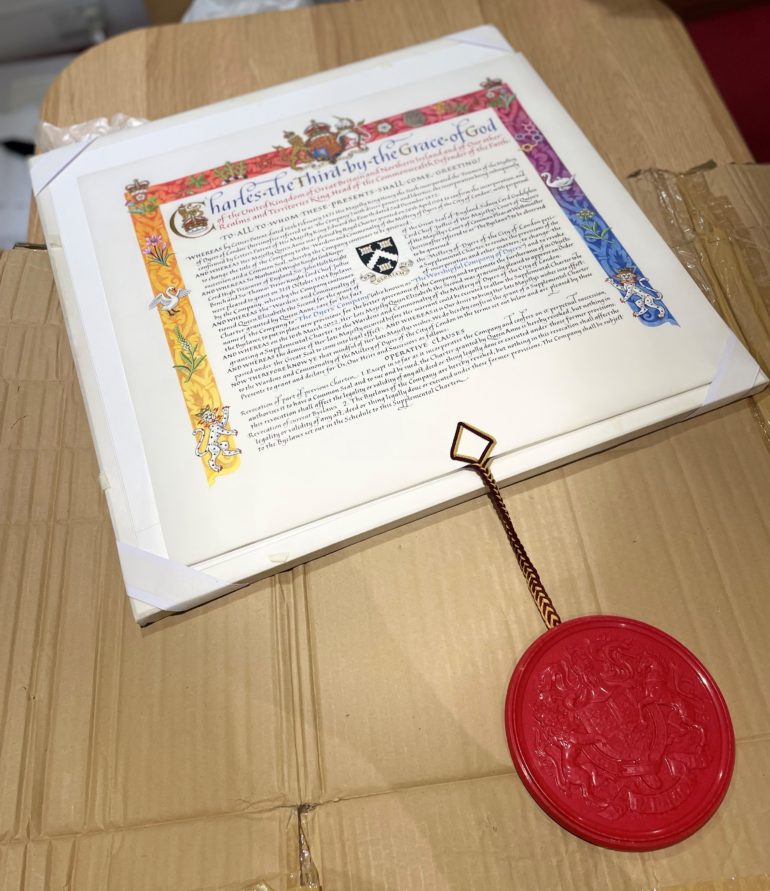
       <p xml:id="emee_TheDyer_p7">Skill was required to accurately determine how much dye was needed in the overall process, with the weight of the fibre proving a key detail to how much dye was used. The weight of thread fibres proved a controversial issue, as some dyers <quote>added deceitful mixtures to increase its weight</quote> (<ref>British History Online</ref>), which led to Royal intervention to incite fines in London for those who tried to sell poor-quality dyed goods. This sentiment ties in with the first Royal Charter for dyers introduced by King Henry VI in 1471.</p>
       <p xml:id="emee_TheDyer_p8">In England, women were barred from performing on stage until the 1660s. The acceptance of women on stage also coincided with their admittance into textile and dyeing guilds, a recognized form of training similar to modern-day labour unions.</p>
    </div>
    <div xml:id="emee_TheDyer_RoleOfImmigrants">
       <head>Role of Immigrants in a <soCalled>Dyeing</soCalled> Industry</head>
       <p xml:id="emee_TheDyer_p9">Scholar Natasha Korda notes that refugees played a key role in revitalizing the clothing industry in England following a depression in the 16th century. Religious persecution of Protestants was common in countries surrounding England, so many of them fled to England. The influx of skilled labour in the cloth trades was a result of England’s acceptance of refugees.</p>
       <p xml:id="emee_TheDyer_p10">Their contributions included:
       <list rend="bulleted">
          <item>New methods for throwing silk <supplied>cleaning, twisting, and preparing the fibers for dyeing and weaving</supplied></item>
          <item>Figured patterns &amp; weaving and embroidery improvements</item>
          <item>An ability to produce luxury-grade materials</item>
       </list>
       </p>
    </div>
    
    <div xml:id="emee_TheDyer_biblioPrint">
       <head>Key Print Sources</head>
       <listBibl>
          <bibl><author>Cardon, Dominique</author>. <title level="a">The Dyer’s Handbook: Memoirs on Dyeing</title>. <publisher>Oxbow Books</publisher>, 2016. pp. 26–40. </bibl>
          <bibl><author>Korda, Natasha</author>. <title level="m">Labors Lost: Women’s Work and the Early Modern English Stage</title>. <publisher>University of Pennsylvania Press</publisher>, 2011.</bibl>  
       </listBibl>
    </div>
    
    <div xml:id="emee_TheDyer_biblioOnline">
       <head>Key Online Sources</head>
       <listBibl>   
          <bibl><author>Cerasano, S.P.</author> <title level="a">An Inventory of Theatrical Apparel (c.1601–2) MS 1, Article 30</title>. <title level="m">The Henslowe-Alleyn Digitisation Project</title>. <ref target="https://henslowe-alleyn.org.uk/essays/an-inventory-of-theatrical-apparel-c-16012/">https://henslowe-alleyn.org.uk/essays/an-inventory-of-theatrical-apparel-c-16012/</ref>. Accessed 10 Jan. 2023.</bibl>
          
          <bibl><title level="a">Dyers and dyeing</title>. <title level="m">Analytical Index to the Series of Records Known as the Remembrancia 1579–1664</title>. Eds. <editor>W. H. Overall</editor>, and <editor>H. C. Overall</editor>. <pubPlace>London</pubPlace>: <publisher>EJ Francis</publisher>, 1878, pp. 118–123. <title level="m">British History Online</title>. Web. 18 Mar. 2022. <ref target="http://www.british-history.ac.uk/no-series/index-remembrancia/1579-1664/pp118-123">http://www.british-history.ac.uk/no-series/index-remembrancia/1579-1664/pp118-123</ref>.</bibl>
          
          <bibl><author>The Dyers’ Company</author>. <title level="a">The Dyers’ Company and dyeing</title>. 2022. <ref target="https://www.dyerscompany.co.uk/dyeing/dyers-and-dyeing/">https://www.dyerscompany.co.uk/dyeing/dyers-and-dyeing/</ref>.</bibl>
          
          <bibl><author>The Dyers’ Company</author>. <title level="a">Royal Charter</title>. 2022. <ref target="https://www.dyerscompany.co.uk/wp-content/uploads/2024/06/Royal-Charter.jpeg">https://www.dyerscompany.co.uk/wp-content/uploads/2024/06/Royal-Charter.jpeg</ref>.</bibl>
          
          <bibl><author>Hohti, Paula</author>. <title level="a">Exploring Historical Blacks: The Burgundian Black Collaboratory</title>. <title level="m">European Research Council</title>, 2019. <ref target="https://refashioningrenaissance.eu/exploring-historical-blacks-the-burgundian-black-collaboratory/">https://refashioningrenaissance.eu/exploring-historical-blacks-the-burgundian-black-collaboratory/</ref>.</bibl>
         
          <bibl><author>Phipps, Elena</author>. <title level="a">Cochineal Red: The Art History of a Color</title>. <title level="j">Museum of Art Bulletin</title>, vol. 67, no. 3, 2010, pp. 2–29. <ref target="https://www.metmuseum.org/met-publications/cochineal-red-the-art-history-of-a-color">https://www.metmuseum.org/met-publications/cochineal-red-the-art-history-of-a-color</ref>.</bibl>
          
          
          <bibl><author>Watt, Melinda</author>. <title level="a">Renaissance Velvet Textiles</title>. Heilbrunn Timeline of Art History.  <title level="m">The Metropolitan Museum of Art</title>. 2011. <ref target="https://www.metmuseum.org/essays/renaissance-velvet-textiles">https://www.metmuseum.org/essays/renaissance-velvet-textiles</ref>.</bibl>
       </listBibl>
    </div>
 </body>
   </text>
</TEI>